
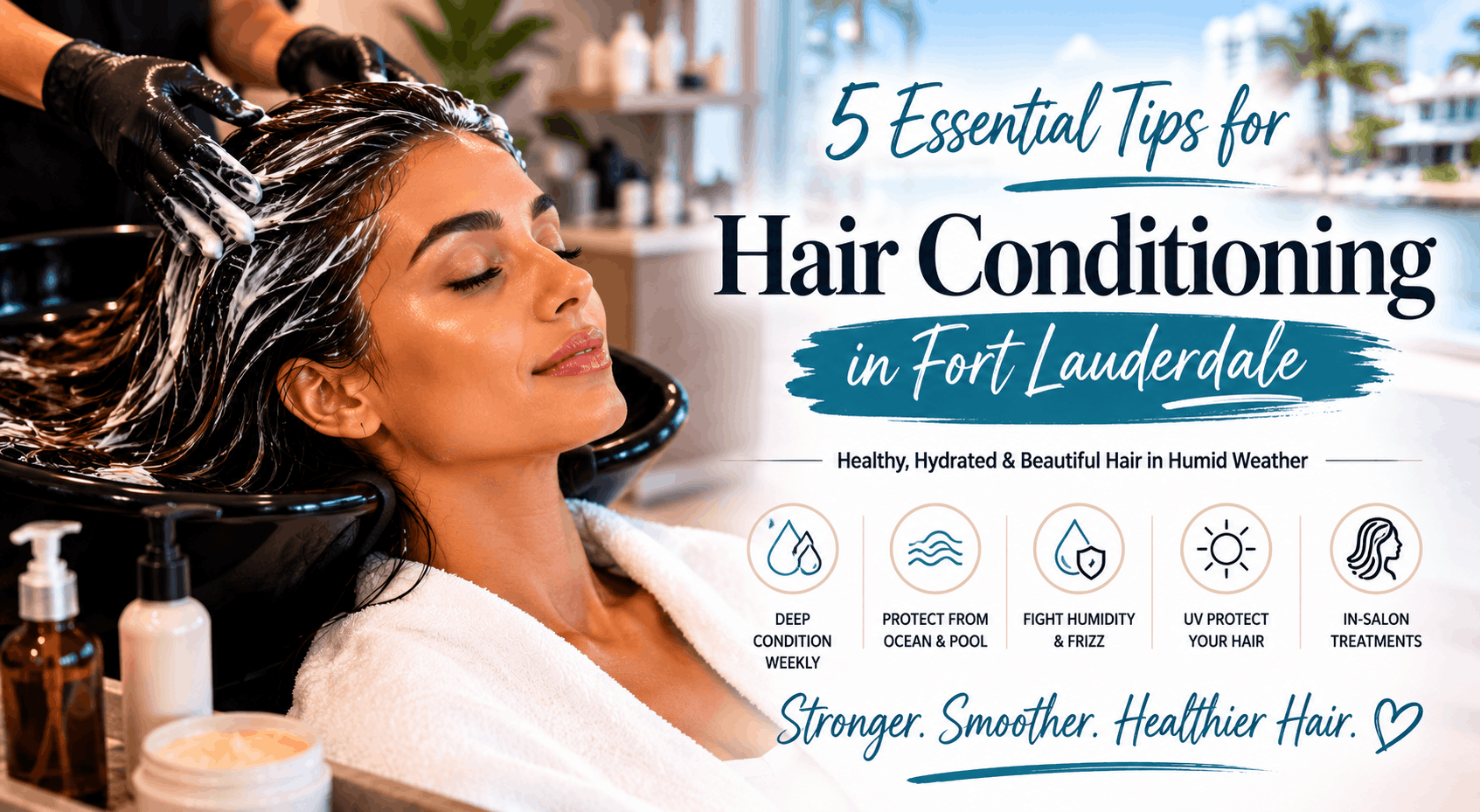
At Randy Schull Salon, we hear this almost every week: “My hair was fine until I moved to Fort Lauderdale.” It’s not your imagination — it’s the climate.
Why Fort Lauderdale Is Uniquely Harsh on Hair
| Climate Factor | What It Does to Your Hair |
| 73% avg. humidity year-round | Swells the cuticle, causes frizz & breakage (weather-and-climate.com) |
| UV Index 7 (May–Sept) | Breaks down hair proteins and fades colour fast (weather-us.com) |
| Saltwater & ocean exposure | Strips natural oils, leaves hair brittle and porous |
| Chlorine from pools | Dries the shaft, causes colour shift in blonde & treated hair |
All of this is not covered by the standard conditioning recommendations, which are for dry or temperate climates.
Tip 1: Deep Condition Weekly — Not Just After Beach Days
Most people don’t think about using a deep conditioner until after a beach weekend. By then, you’re playing catch-up. The humidity of the day gradually strips away moisture from your hair before you can do hair conditioning Fort Lauderdale residents need to have a proactive routine to condition their hair effectively, as damage accumulates daily.
How to do it right:
• Use a deep conditioning mask using shea butter, argan oil or coconut oil.
• Work into clean, damp hair — not dry hair
• Leave on for a minimum of 20 minutes and then rinse with cool water to close the cuticle.
• Always use a colour-safe formula for colour-treated or lightened hair — UV fading further reduces moisture loss.
This one change has made a difference in the condition of clients’ hair in as little as a month, particularly for those with colour-treated hair who are struggling with the South Florida sun.
Tip 2: Pre-Wet Before You Enter the Ocean or Pool
Hair is spongy — already moistened hair absorbs much less salt and chlorine. Taking a 30-second rinse just prior to swimming is a measurable difference.
Your pre-swim checklist:
✓ Before entering the beach shower, rinse hair with fresh water
✓ Using a leave-in conditioner, apply a light layer or a few drops of argan oil to form a barrier.
✓ Rinse after swimming (not necessarily shampooing).
✓ Don’t leave salt water in the hair at night—salt crystals will suck up moisture when they dry out
Tip 3: Conditioner that fights humidity, not just moisture.
Humidity does not hydrate your hair; it destabilises it. Moisture is forced into the cortex by high-humidity air, causing the cuticle to swell. This is what leads to frizz. A regular moisturising conditioner can make this worse if it opens the cuticle.
What to look for on the label:
• Panthenol — smooths and seals the cuticle layer.
• Hydrolysed keratin — fills gaps in damaged hair structure
• Silk protein — creates a light film that prevents frizzing on each strand.
• Anti-humidity serum — apply to damp hair before styling to lock the cuticle shut
Even with a good at-home routine, you’re still dealing with frizz? A professional keratin texture treatment or keratin blowout restructures the hair shaft so humidity has far less to grab onto – results no at-home product can replicate.
Tip 4: Protect Your Hair from UV — Just Like You Protect Your Skin
UV rays break down the disulphide bonds in your hair’s protein structure — the bonds that give hair its strength and elasticity. In Fort Lauderdale, where the UV index hits 7 from May to September, this happens faster than most people realise.
Signs of UV-damaged hair:
- Colour fading 1–2 weeks later than expected
- Strands that break easily when pulled.
- Dullness that deep conditioning doesn’t fully fix
No softness or smoothness after washing
What to do:
✓ Apply a leave-in conditioner that contains UV filters when you are outside.
✓ Wear a wide-brimmed hat for extended beach or pool days
✓ If you’ve recently had a colouring service, UV protection is a must — colour fades much quicker without it.
If you forget your hat one week, you’ll know you need it at your next appointment.” — Randy Schull Salon stylists
Tip 5: Add a Monthly In-Salon Conditioning Treatment
The surface is treated at home. Professional treatments work structurally — penetrating deeper into the cortex to restore elasticity, moisture retention, and smoothness that retail products can’t reach.
At-home vs. in-salon – the real difference
| At-Home Conditioning | In-Salon Treatment |
| Retail-grade formulas | Professional-grade, higher concentration |
| Coats the surface | Penetrates the cortex |
| Generic to hair type | Assessed & tailored per client |
| Maintains your baseline | Resets & restores deeper damage |
At Randy Schull Salon, every conditioning treatment starts with an assessment – your texture, lifestyle (weekend beach sessions? daily pool?), and colour history. There’s no one-size-fits-all formula for Fort Lauderdale hair.
Your Fort Lauderdale Hair Conditioning Cheat Sheet
| Tip | Frequency | Priority Level |
| Deep conditioning mask | Weekly | Essential |
| Pre-swim fresh water rinse | Every swim | Essential |
| Humidity-blocking conditioner | Every wash | Essential |
| UV protection (leave-in or hat) | Daily (May–Sept) | High |
| In-salon conditioning treatment | Monthly | High |
Ready for Hair That Actually Works in South Florida?
Book your professional hair conditioning treatment at Randy Schull Salon. Let’s create a plan that works in the real world in Fort Lauderdale.